
News
Guest Editorial – New Standards for Adolescent Substance Use Disorder Care
If we hope to improve our response to the addiction and overdose crisis, we must focus on when addiction commonly starts: adolescence. Addiction is a pediatric-onset illness, as ongoing neurodevelopment makes the adolescent brain particularly vulnerable to the effects of substances. In fact, 80% of adults with substance use disorder (SUD) begin using substances before the age of 18.1,2 Not only is the neurobiology of adolescents unique, but so are their social, educational, and mental and physical health needs.
Individualizing treatment to a patient's distinct biopsychosocial needs is a foundational principle of The ASAM Criteria®. Since 1991, The ASAM Criteria has established standards to guide clinicians in assessing patients and recommending them to a level of care appropriate for their specific needs. The Criteria also describes the continuum of care that should be available and establishes service characteristic standards for each level of care, along with patient assessment standards, admission criteria, and treatment planning standards. The goal is to provide a common language for the SUD treatment system,3 and thereby bring much-needed standardization to an SUD treatment infrastructure that has historically been fragmented.
In The ASAM Criteria, Third Edition, treatment standards for adolescents were interwoven with those for adults. But since its publication in 2013, research and clinical best practices in adolescent SUD care have evolved significantly, prompting the need for a comprehensive update.
When ASAM began developing the Fourth Edition in 2021, the organization chose to create a separate volume and set of standards for adolescents and transition-aged youth. This focused and dedicated approach was needed to comprehensively address the needs of adolescents with SUD and eliminate confusion with adult standards.
The result is the newly published Adolescents and Transition-Aged Youth volume of The ASAM Criteria, Fourth Edition. This marks The ASAM Criteria's first comprehensive and dedicated set of treatment standards and admission criteria for youth who have an SUD or are at risk of developing one.
These standards are intended to provide consistency in:
- assessing the biopsychosocial circumstances of each patient and family to identify an appropriate level of SUD care based on individual needs
- developing comprehensive, individualized, family-driven, and youth-guided treatment plans
- defining the services that should be available at each level of care in the continuum of care.
These standards were created using a rigorous methodology for evidence review and consensus development. Feedback from payers, policymakers, providers, parents, families, and other stakeholders helped identify areas of improvement from the Third Edition. Consequently, the final standards are guided by advances in research and clinical practices and include key updates to better reflect the unique developmental needs of adolescents to improve immediate health outcomes and long-term well-being.
Recognition of Transition-Aged Youth
One of the most prominent updates is the specific consideration of transition-aged youth, defined as young people between the ages of 16–25. This designation is intended to capture the period of transition related to independence, social roles and responsibilities, and neurodevelopment that occurs as an adolescent transitions to adulthood.4 During this time period, youth are gaining independence — working, driving, attending college or vocational school — but may still be dependent on family in some capacity. Their potential exposure to substances also increases as they may be around friends or peers who are engaged in substance use at college or in work settings.
Significant neurodevelopment also occurs across these ages. The regions of the brain responsible for executive functioning and emotion regulation approach full maturity during these years.5 Substance use can delay this critical development, impairing one's ability to build foundational skills such as planning, problem solving, and impulse control.
Given that this age group has unique developmental needs compared to younger adolescents and older adults, these standards include transition-aged-youth-specific considerations for SUD treatment. For example, this volume stresses that treatment interventions should be developmentally appropriate, with both adolescents and transition-aged youth receiving treatment in peer-specific groups separate from adults. Further, substance use can impede the attainment of key milestones that typically occur in this age range, such as completing education and securing employment. The standards emphasize the role of the SUD treatment system in helping young people work towards achieving these milestones as part of their treatment journey, establishing the foundation for successful long-term recovery.
Meeting the Unique Developmental Needs of Adolescents and Transition-Aged Youth
Both younger adolescents and transition-aged youth have unique developmental needs that the SUD treatment system should be organized to meet. With these distinct biopsychosocial considerations in mind, the updated adolescent and transition-aged youth standards promote the following:
- Coordination across systems of care. There are a range of systems that may impact adolescents and support their treatment and recovery needs including schools, child welfare agencies, health care providers, juvenile legal systems, and informal supports, including 12-step programs, youth centers, faith-based programs, recreational programs, and other community-based resources. Consistent messaging, alignment on treatment plan goals, and the coordination of resources across these touchpoints are critical. A systems-of-care approach is an evidence-based approach to adolescent mental health treatment,6 and a core tenet of The ASAM Criteria's new adolescent SUD treatment standards.
- Comprehensive family services. Children do well when families do well. Clinicians should consider a patient's family as part of the unit of care, therefore all levels of care in the adolescent continuum are expected to offer family services. Family units may look different for each child, which is why The ASAM Criteria adopted an inclusive definition of "family" that is not limited to biological families and may include anyone the patient has a strong attachment to, such as foster parents or other trusted adults.
- Fully integrated mental health treatment. Among adolescents, co-occurring mental health conditions are an expectation, not an exception. Approximately 50% to 90% of adolescents with SUD have a co-occurring mental health disorder.7 Due to these high rates, all levels of adolescent care are expected to provide fully integrated mental health care.
- Trauma-sensitive practices. Adverse childhood experiences (ACEs) are closely linked to the development of SUD and mental health conditions.8 These new standards encourage programs to focus on addressing health consequences resulting from trauma, preventing further traumatization, and building positive childhood experiences that may reduce risk for SUD in adulthood.
- Early intervention and prevention. Secondary prevention and early intervention can prevent risky substance use from progressing to SUD and SUD from intensifying to the chronic disease of addiction.9,10 This volume of The ASAM Criteria recommends that adolescents who are using substances and at risk for rapid escalation to SUD should receive early intervention services in the specialty SUD continuum of care (ie, Level 1.5Y, or in 2.1Y when more intensive services, including wraparound service planning and home-and-community-based services, are indicated).
A New Adolescent Continuum of Care
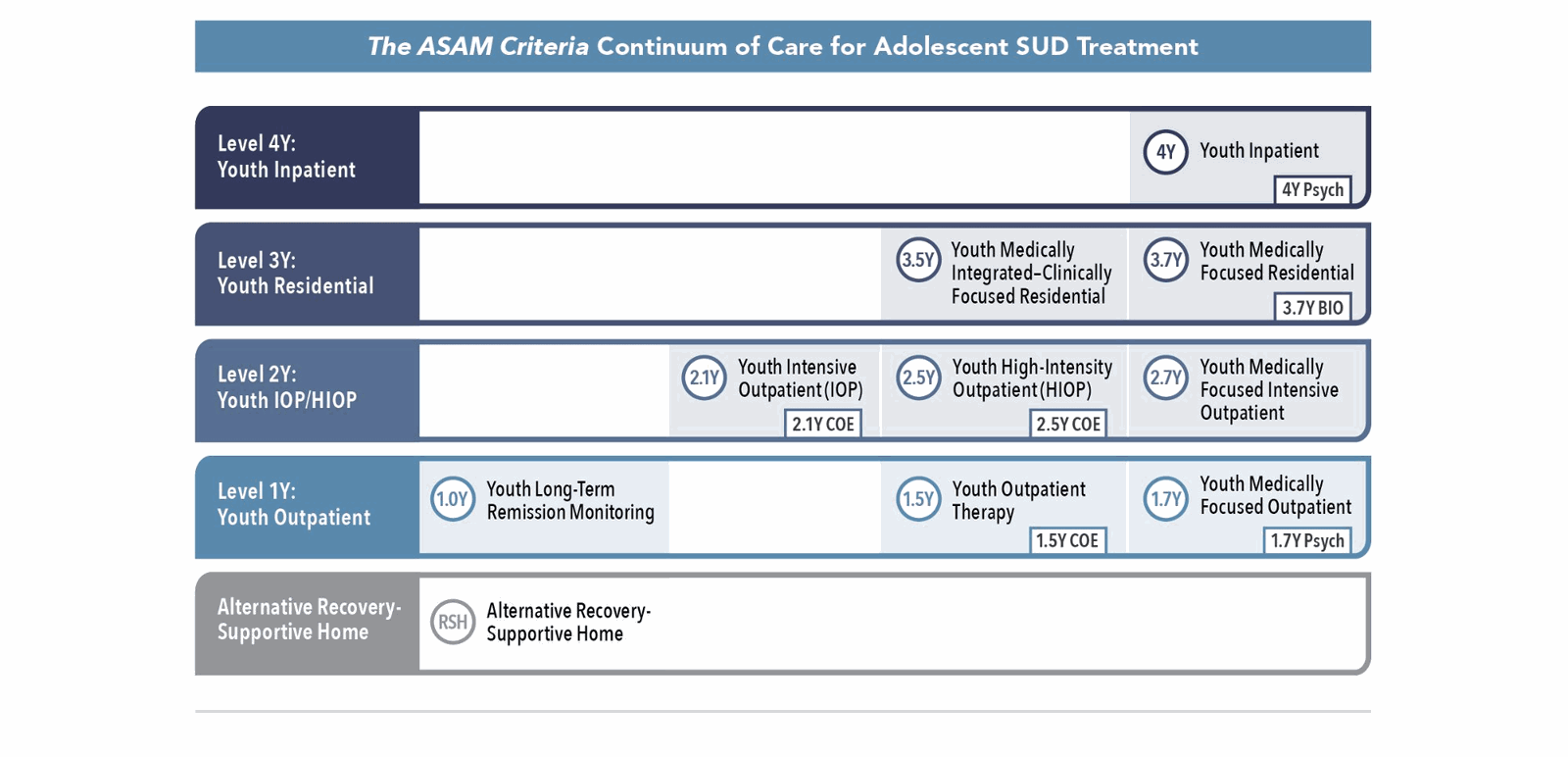
These treatment considerations, among others, are reflected in the updated adolescent continuum of care. As with past volumes, the continuum includes four broad levels of care that outline different treatment settings and intensities of care, ranging from youth outpatient treatment (Level 1Y) to youth inpatient treatment (Level 4Y). Patients are recommended a level of care along the continuum based on their biopsychosocial needs, and they move along the continuum of care, to more- or less-intensive levels, based on their progress, outcomes, and evolving needs.
The vulnerabilities of the developing adolescent brain make early intervention and reintervention a priority. As such, the adolescent continuum of care includes a new Level 1.0Y: Youth Long-Term Remission Monitoring. This level of care provides regular recovery management checkups for patients who are in sustained remission. Ongoing monitoring allows clinicians to identify early signs that a patient might be resuming or at risk of resuming substance use and rapidly intervene to help them reengage in treatment and recovery.
The new continuum also includes medically focused levels of care, identified as Levels 1.7Y, 2.7Y, 3.7Y, and 4Y. Historically, significant withdrawal and biomedical comorbidities have been less common among adolescents compared with adults, and most areas of the country lack adolescent-specific programs that deliver withdrawal management and biomedical care. However, anecdotal evidence suggests that adolescents have a growing need for medical management with the increasing prevalence of high-potency synthetic opioids (eg, fentanyl) in the drug supply.
The Fourth Edition of The ASAM Criteria also expects that all levels of care provide co-occurring capable care. As mentioned earlier, in the adolescent continuum of care, co-occurring capability includes fully integrated mental health care.
Bridging the Gap: Making the Continuum a Reality for Patients
Patient and family access to the full continuum of care is necessary to support individualized treatment. However, this volume acknowledges that much of the country does not currently have access to the full adolescent continuum. For example, youth residential treatment (Level 3Y) remains inaccessible to some due to long waiting lists, high costs with low Medicaid acceptance, and a simple lack of facilities (a 2024 study found that ten states have no adolescent residential facilities).11 There are also few programs that serve adolescents in need of withdrawal management services.
It was important in the development of this volume to not only establish these standards but also provide solutions to help implement them with fidelity. As an example, this volume discusses potential strategies for increasing access to withdrawal management services, such as by establishing:
- adolescent-focused units within adult SUD treatment programs that provide medically managed care
- medically focused units within clinically focused adolescent SUD treatment programs
- medically focused SUD treatment units within adolescent mental health treatment programs.
In the months ahead, ASAM will also release new tools and training resources to equip treatment programs with the knowledge and confidence to put these new standards into practice. This will include a level of care assessment guide, a treatment planning assessment guide, a treatment planning template, standardized service request forms for requesting payer authorizations, and additional training resources to support the important work of treatment providers.
There will certainly be challenges to overcome as we continue to develop this adolescent SUD treatment infrastructure. Outlining these new standards and creating implementation tools is the first step of many. We must commit to building out these systems and developing payment models that support the delivery of effective, evidence-based care for all young people in need.
Creating a robust adolescent treatment system is important not only to prevent tragic overdoses or acute health complications, but also to build foundational health and necessary life skills needed for today's children to develop into the successful, healthy adults of tomorrow. This is how we can begin to break the cycle of addiction and invest in the well-being of our children, families, and communities.
Read an executive summary of the Adolescent and Transition-Aged Youth volume here.About the Authors
The authors are members of the editorial subcommittee for The ASAM Criteria, Fourth Edition, Volume 2: Adolescents and Transition-Aged Youth. Dr. Waller is the editor in chief of The ASAM Criteria, Fourth Edition. Dr. Gomez-Luna is the lead adolescent editor. Drs. Fortuna, Hadland, and Metz served as section editors.
References
- Substance Abuse and Mental Health Services Administration. Results from the 2022 National Survey on Drug Use and Health: Detailed Tables. November 13, 2023. Accessed March 6, 2024. https://www.samhsa.gov/data/report/2022-nsduh-detailed-tables
- Substance Abuse and Mental Health Services Administration. Results from the 2023 National Survey on Drug Use and Health: Detailed Tables. July 30, 2024. Accessed August 29, 2024. https://www.samhsa.gov/data/report/2023-nsduh-detailed-tables
- Guyer J, Traube A, Deshchenko O, et al. Speaking the same language: a toolkit for strengthening patient-centered addiction care in the United States. American Society of Addiction Medicine. Published January 21, 2025. Accessed March 3, 2026. https://downloads.asam.org/sitefinity-production-blobs/docs/default-source/quality-science/asam-toolkit-speaking-same-language-2025-update_4.1.0.0.pdf
- Wood D, Crapnell T, Lau L, et al. Emerging Adulthood as a Critical Stage in the Life Course. In: Halfon N, Forrest CB, Lerner RM, Faustman EM, eds. Handbook of Life Course Health Development. Springer; 2018. https://www.ncbi.nlm.nih.gov/books/NBK543712/
- Tervo-Clemmens B, Calabro FJ, Parr AC, Fedor J, Foran W, Luna B. A canonical trajectory of executive function maturation from adolescence to adulthood. Nat Commun. 2023;14(1):6922. doi:10.1038/s41467-023-42540-8
- American Academy of Child and Adolescent Psychiatry (AACAP) Committee on Community-Based Systems of Care and AACAP Committee on Quality Issues. Clinical Update: Child and Adolescent Behavioral Health Care in Community Systems of Care. J Am Acad Child Adolesc Psychiatry. 2023;62(4):367-384. doi:10.1016/j.jaac.2022.06.001
- Richert T, Anderberg M, Dahlberg M. Mental health problems among young people in substance abuse treatment in Sweden. Subst Abuse Treat Prev Policy. 2020;15(1):43. doi:10.1186/s13011-020-00282-6
- Broekhof R, Nordahl HM, Tanum L, Selvik SG. Adverse childhood experiences and their association with substance use disorders in adulthood: A general population study (Young-HUNT). Addict Behav Rep. 2023;17:100488. doi:10.1016/j.abrep.2023.100488
- Griffin KW, Botvin GJ. Evidence-based interventions for preventing substance use disorders in adolescents. Child Adolesc Psychiatr Clin N Am. 2010;19(3):505-526. doi:10.1016/j.chc.2010.03.005
- US Department of Health and Human Services (HHS), Office of the Surgeon General. Facing Addiction in America: The Surgeon General's Report on Alcohol, Drugs, and Health. Washington, DC: HHS, 2016. Accessed May 23, 2025. https://www.hhs.gov/sites/default/files/facing-addiction-in-america-surgeon-generals-report.pdf
- King CA, Beetham T, Smith N, et al. Adolescent residential addiction treatment in the US: Uneven access, waitlists, and high costs. Health Aff (Millwood). 2024;43(1):64–71. doi:10.1377/hlthaff.2023.00777